Saturday, February 5, 2011

Gettin' our boots muddy

Muddy Boots' ventures into the wintry woods
This morning Muddy Boots Family Nature Club paid a visit to Tryon Creek. About fifty people participated in the morning's activities...

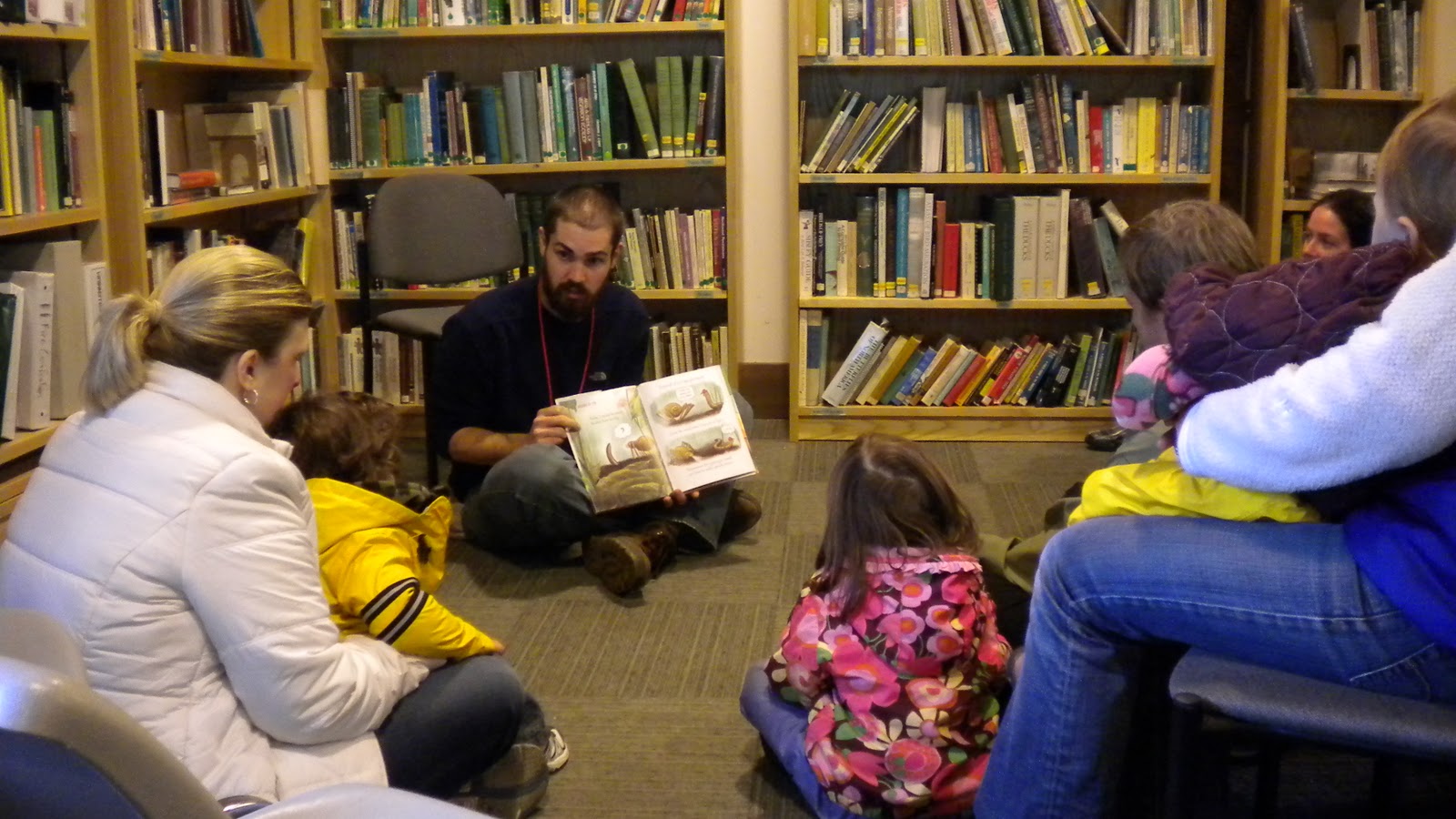
Matthew Collins reads Diary of a Worm to families
First stop: Story time! Muddy Boots' members listened to Diary of a Worm, a truly wonderful (and hilarious) children's book about the trials and tribulations of life as an earthworm. (Side note: A play about the book, Diary of a Worm, a Spider and a Fly, is playing at the Oregon Children's Theater through February 20th. It is a delightful production and fun for the whole family.)


The lowly earthworm - an essential park resident
After the story hikers bundled up and hit the trail. It was chilly but no one complained. Children and adults alike got up close and personal with one of the park's most important residents: The earthworm. Hiking guides explained how they breathe (through their skin!), whether or not they grow back their missing half if they get separated (they do, as long as the part includes their hearts and brain), how they prefer to while away the winter hours (curled up inside mounds they create out of dirt), and many more fascinating facts.

OPB gets some candid shots for a fall episode of Oregon Field Guide featuring Muddy Boots at Tryon Creek
After digging in the dirt and investigating the park's flora and fauna hikers returned to the Nature Center for some hot cider - a perfectly delicious way to warm up and reflect on the wonderful experience of adventuring in the forest.

Warm thanks to Muddy Boots' Jess Hoylman and Angela Fojtik. Their shared inspiration to create a family nature club is a wonderful thing.  The Friends of Tryon Creek enjoyed partnering with them for today's activities.

Tuesday, January 18, 2011

Muddy Boots at Tryon Creek

I recently had the good fortune of meeting Angela Fojtik and Jess Hoylman, the dynamic duo behind Portland's family nature club, Muddy Boots. Next month the Friends of Tryon Creek are hosting Muddy Boots on a guided hike through the park. Hikers of all ages will participate (must be the hike's "Winter Worms" theme!) and get their hands - and boots! - dirty.

Muddy Boots is the brainchild of Jess Hoylman. She was assigned the task of crafting a Community Action Project of her own design while completing her AmeriCorps term at the Northwest Service Academy (NWSA), an environmentally focused AmeriCorps program operating in Oregon and Washington. The end result was Muddy Boots, a nature club she was inspired to organize after hearing Richard Louv, author of "Last Child in the Woods", speak at the Nature Play Summit in Vancouver, Washington in June 2010.

Richard Louv has had an immeasurable impact on the way society views children and their relationship to the outdoors. After publishing his book, Louv partnered with other like-minded individuals who shared his passion for promoting the importance of getting kids out in nature and combating what Louv termed, "Nature Deficit Disorder". Together, Louv's group formed the Children and Nature Network (C&NN). Their objective is to get children outside and engaged with the natural world.

After hearing Richard Louv speak, Jess was moved to take action. Her Community Action Plan needed to serve the community - what better way than to provide a vehicle for getting families out and about in Portland-area parks! C&NN provided a model for a family nature club. Jess expanded it and used her background and expertise to build more structure into the program. Angela Fojtik, who Jess met while attending NWSA, shared Jess' vision and together they made Muddy Boots into an accessible hiking club.

Muddy Boots' first official hike in November 2010 was a great success. A dozen families from around the Portland area got together, hit the trail and spent time getting to know each other and the landscape. Jess and Angela have chosen Tryon Creek as the site of Muddy Boots' second hike. The Friends are looking forward to guiding them - and providing them with an opportunity to get up close and personal with one of the park's most important residents: The lowly earthworm.

For more information about Muddy Boot follow this link: http://www.muddybootspdx.org/. To learn more about the Children & Nature Network follow this link: http://www.childrenandnature.org/news/center/

Tuesday, December 21, 2010

Watersheds 101

"Watershed" has been a buzzword I've been hearing since I joined the Friends of Tryon Creek. It is an important component of the park so this morning I met with Terri Preeg Riggsby, Tryon Creek's resident watershed expert and member of the Tryon Creek Watershed Council (TCWC), to learn more.

Terri has been with TCWC for ten years and has gleaned a great deal of information about the region. She explained that a watershed is a geographical area that is bordered by high elevation from which water flows downhill to lower elevations. In the case of Tryon Creek's 4,200-acre watershed, water runs to area tributaries and then into the creek and eventually into the Willamette River.

Ideally, water flowing into area waterways would be filtered through the ground to underground streams. This would allow for cleaner, cooler water which is necessary for healthy ecosystems. The current reality is that much of the stormwater ends up running down our streets and into drains and the sewer system. It eventually ends up in the river along with all the unhealthy particles it picks up along the way. The result? Warmer, polluted water that contributes to turbidity and erosion.

The mission of the Tryon Creek Watershed Council is to preserve and protect area waterways, increase ground-access for water, and educate the community about the importance of the watershed and its contribution to clean water and the general health of the environment. I have a new respect and appreciation for the work of the TCWC and am pleased they are a partner to the Friends.

For more info on the Tryon Creek Watershed Council please visit http://tcwc.tryonfriends.org/index.html

Tuesday, December 14, 2010

Hooray for Outdoor Education!

Capitol Hill 2nd Graders learning about pond life

"Kids who play outside are simply more focused, healthier and happier." - Jason Mark, writer for The Earth Island Journal

I have been taking my two children to Tryon Creek since they were babies. I would strap them to my chest, a la Baby Bjorn-style, and traipse along the park's forested paths, breathing in the fresh clean air, admiring the lush green space around me and enjoying some relatively calm and centered moments amid the chaos of daily child rearing.

As my children grew, I took to planting them on Tryon Creek's trails on their own two feet, expecting their curiosity and energy levels to run wild. And, while they didn't seem to mind being in the natural world, they didn't display nearly the interest or appreciation I hoped they would.

Until now.

I have discovered the key: Hands-on experience with outdoor education. A few weeks ago I blogged about No Oregon Child Left Inside.  The purpose of this act is to provide opportunities for children to explore and learn about nature in order to encourage stewardship of the land by nurturing and inspiring an appreciation of the outdoors.

Last month I began taking my kiddies on guided hiking tours of Tryon Creek. The interest those hikes have generated is through the roof! Now my kids ask to visit the park on a near daily basis. They look for things they learned about on past hikes and ask questions about plants and creatures that are new to them (alas, I am no naturalist so I have to leave the answers until the next time we are with a park expert). They have chosen to write about their park visits at school unprompted. Now, that's something new! And, they always express concern when they see a sight along the trail that has been disturbed (joggers, you know not the damage you can do to a rough skinned newt.).

My children's cheeks are rosier then ever, their young legs are strong and sturdy, and they radiate enthusiasm and joy with each and every hike. A heartfelt thanks to outdoor educators!

(Click here to read Jason Mark's take on No Child Left Inside: http://www.earthisland.org/journal/index.php/elist/eListRead/no_child_left_inside)

Monday, December 6, 2010

Holiday Forest Market

The Friends of Tryon Creek welcomed the public to the park's Nature Center for their annual holiday Forest Market on December 4th & 5th. At the event I admired the handiwork of local artisans and authors while my children made Christmas ornaments out of recycled items. The setting was very intimate so I was able to visit with many of the vendors and learn about their wares which featured everything from chocolate and candles to note cards, books and reclaimed-materials-turned-into-yard-sculptures.

Families enjoyed making decorations out of recycled items...

...while shoppers checked out (and sampled) yummy Oregon honey from The Bee Hive (I bought three jars!). 

Pamela Yocum's ceramic designs. These were absolutely stunning. (http://www.pamelayocum.com/Ceramics/Contact_Me.html)

Susan Burson's exquisite pine needle baskets (that's right! The woven portion of these gorgeous pieces are made by hand using pine needles).

Saturday, November 27, 2010

No Oregon Child Left Inside

Second-graders from Capitol Hill School visiting the Audubon Society of Portland (2010)

Recently the Friends of Tryon Creek hosted an event featuring guest speaker Traci Price from the Freshwater Trust. Traci's Mission: To educate the public about new state legislation known as the No Oregon Child Left Inside (NOCLI) Act.

In July 2009 Governor Kulongoski signed the No Oregon Child Left Inside Act into law and noted that “…the ‘No Oregon Child Left Inside Act’ will provide our youth with classroom instruction about our vital natural resources and an opportunity to conduct field investigations in an outdoor learning setting. This experience is fundamental to our children and will help them develop a sense of stewardship towards Oregon’s environment and help them make informed decisions about our natural resources in the future.”

Governor Kulongoski's words added a new dimension to Oregon's longstanding commitment to environmental protection: The importance of providing educational opportunities for children in order to ensure their exposure to the outdoors and positively influence their knowledge and understanding of the natural world. Countless studies have demonstrated that children thrive when given such opportunities. It is heartening to learn that Oregon is championing environmental advocacy, this time in the arena of children's outdoor education.

The NOCLI Act is intended to work in conjunction with federal No Child Left Inside legislation (No Child Left Inside currently has 84 sponsors in the House of Representatives including Representative David Wu and Representative Earl Blumenauer).  The partnership of these acts seeks to ensure that funds will be available at the state level for outdoor education programs for children.

This is excellent news for the Friends of Tryon Creek. Our organization, in partnership with the Oregon Parks and Recreation Department, currently provides a multitude of classes, workshops and camps for the purpose of engaging children in the Great Outdoors. The No Oregon Child Left Inside Act recognizes the importance of such opportunities.

(Here is the link for more information on the No Oregon Child Left Inside Act: http://friendsoftryoncreek.blogspot.com/2010/11/no-oregon-child-left-inside.html)

Monday, November 22, 2010

Ethnobotany

This weekend my family and I enjoyed another one of Ranger Christal's guided hikes in Tryon Creek park. The day was chilly and drizzly but once the tour started we hardly noticed: Our focus was directed at all the interesting things living in the park.

The topic of the hike was "ethnobotany", a fancy word that basically means the study of the relationship between people and the plants they use.

The first plant we encountered was the thimbleberry. In addition to having delicious berries it also known as "Nature's Toilet Paper", the proverbial Charmin of the plant world, if you will. The leaves are soft and thick (double-ply, in TP-speak).


 The first tree we came across was this Hazelnut tree. Also known as the Western Filbert, this variety of tree is generally prolific with nuts. However, because shade abounds in Tryon Creek, this specimen produces only a few.

These are leaves from a salmonberry plant. There are actually three leaves per stem but if you bend the middle leaf back it looks like a butterfly. Salmonberries are edible and good for you but they tend to be on the tart side.

 This is Tryon Creek. It is fed by natural springs and tributaries as well as the run-off from the streets of southwest Portland. When I think of all the rain we get flowing to storm drains and then on to the creek, carrying oil and silt from city streets along with it, I really feel for the creatures in this ecosystem.

Take this critter, for example. He (or she) is a Rough Skinned Newt, a species of salamander that resides in the park. This poor critter was found seemingly crushed on the side of a trail. It looked like he wasn't going to make it and the kids in our hiking group were very concerned (although it did provide a good lesson in keeping one's eyes open when exploring the park). However, with Ranger Christal's attention and care, this newt survived and was freed near Tryon Creek later in the day.

I have seen this particular evergreen shrub in western Oregon all of my life and I never knew that it is the Oregon State Flower, the Oregon Grape. It produces yellow flowers in late spring and small purplish/black berries that are quite tart and contain large seeds.

(Please note: Specimen handling or collecting is prohibited at Tryon Creek without a permit.)